
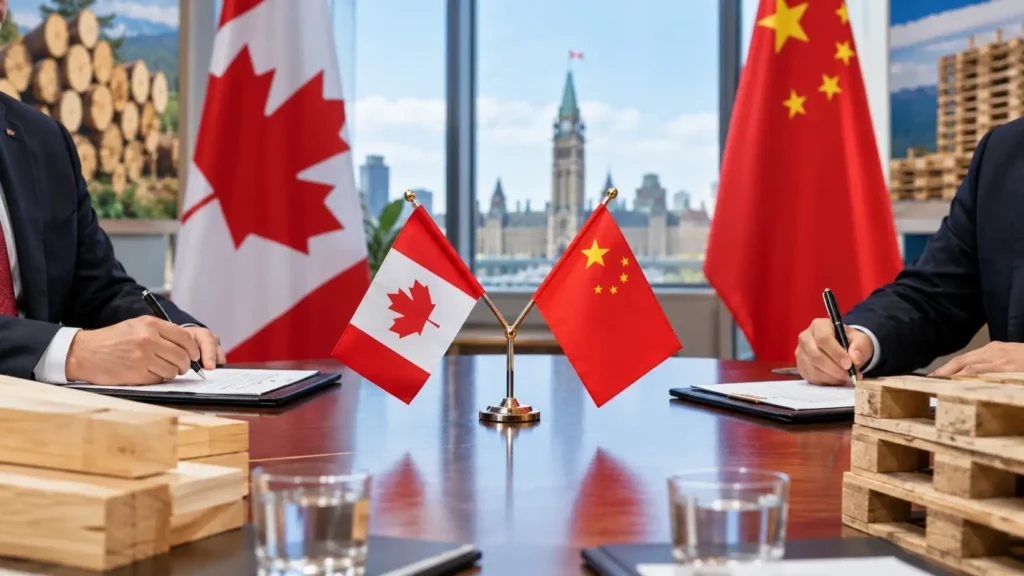
On January 16, 2026, Canada announced that it is taking a fresh step to expand international market opportunities for Canadian wood products. Natural Resources Canada (NRCan) has signed a Memorandum of Understanding (MOU) with China’s Ministry of Housing and Urban-Rural Development (MOHURD) to increase cooperation on modern wood construction and to help create new export opportunities for Canada’s forest-products sector.
Industry groups welcomed the move, describing it as a practical way to build on years of technical collaboration and grow the role of Canadian wood in China’s construction market.
What is an MOU. And what does this one actually do?
An MOU is a formal agreement that sets the direction for cooperation. It is not the same thing as a purchase order, and it does not guarantee sales. But it can make it easier for governments, agencies, and industries to work together on things like:
- Building standards and best practices for wood construction
- Training and knowledge-sharing (how to design, test, and build with modern wood systems)
- Demonstration projects and technical collaboration that help wood construction scale faster
In plain terms: it helps remove friction, increases trust, and makes it easier for Canadian wood products (and Canadian expertise) to compete in a major global market.
Why Canada is doing this now
This wood-products MOU sits inside a broader Canada–China “reset” that includes trade and investment discussions. Prime Minister Mark Carney’s Beijing visit (the first Canadian PM visit to China since 2017) was framed as part of Canada’s push to diversify trade and strengthen economic resilience.
As part of the broader package described publicly, Canada also announced a reduced-tariff quota for up to 49,000 Chinese EVs (6.1% tariff rate), while China is expected to lower tariffs on Canadian canola seed to about 15% effective March 1, 2026, with additional agricultural tariff relief outlined as well.
Why this matters for the wood products sector
Even if you do not work in forestry, this matters because wood is a foundational input for a lot of Canada’s real-world supply chain: construction materials, packaging, pallets, crates, and industrial shipping systems.
If cooperation on modern wood construction expands demand for Canadian wood overseas, it can have ripple effects:
- More export pull for Canadian wood products
- More focus on value-added wood (engineered wood, prefabrication-friendly products, standardized specs)
- More pressure on planning around supply, lead times, and logistics lanes
The connection to pallets and 3PL logistics
This is the part people often miss: when a country grows its export footprint, it also grows its need for industrial packaging and freight movement.
More wood products moving internationally can increase demand for:
- Export-ready pallets and crates (including compliance requirements, depending on destination)
- Warehouse throughput: cross-docking, storage, consolidation, and container loading
- Reverse logistics: repair programs, retrieval, and reuse systems to reduce total cost per trip
For the pallet market specifically, bigger export lanes can also shift how the market behaves. When more wood is pulled into higher-value end uses (like construction), pallet producers and repair networks have to be sharper about yield, recovery, and lifecycle value. That is where repair, reuse, and pooling-style thinking becomes a competitive advantage.
How Advance Pallet and Lumber will leverage this
We view developments like this as a signal to double down on what we already do best: keep supply chains moving with practical, cost-focused wood packaging solutions.
Here is how we plan to position around the opportunity:
- Support export-oriented customers with reliable capacity. As trade lanes shift, businesses need predictable pallet supply, consistent specs, and fast turnaround.
- Lean harder into lifecycle value, not “one-and-done” pallets. Repair, reuse, and recovery reduce total packaging spend and protect supply when markets tighten.
- Build stronger logistics coordination with shippers and 3PL partners. When exports rise, the winners are the companies that reduce touches: consolidate, stage, load, and move efficiently.
- Stay agile on sourcing and product mix. If demand shifts toward certain wood products, we adjust quickly so customers are not stuck waiting on packaging.
- Focus on damage prevention. International freight is unforgiving. Better pallet condition and better unit loads protect product, reduce claims, and reduce delays.
What to watch next
If this cooperation expands in real terms, you will likely see a few “leading indicators” in the market:
- More announcements around standards, training, and demonstration projects in modern wood construction
- A stronger Canadian push for export diversification and new market access beyond the U.S.
- More customers asking for export packaging readiness and tighter logistics execution
Bottom line
This MOU is a pro-trade signal for Canadian wood products. It is not a guarantee of immediate sales, but it is a meaningful step that can open doors over time. And when doors open for Canadian exports, the pallet and 3PL world moves with it.
If you want to talk through what this could mean for your packaging flow, warehouse throughput, or pallet lifecycle costs, Advance Pallet and Lumber can help you map out a practical plan.