
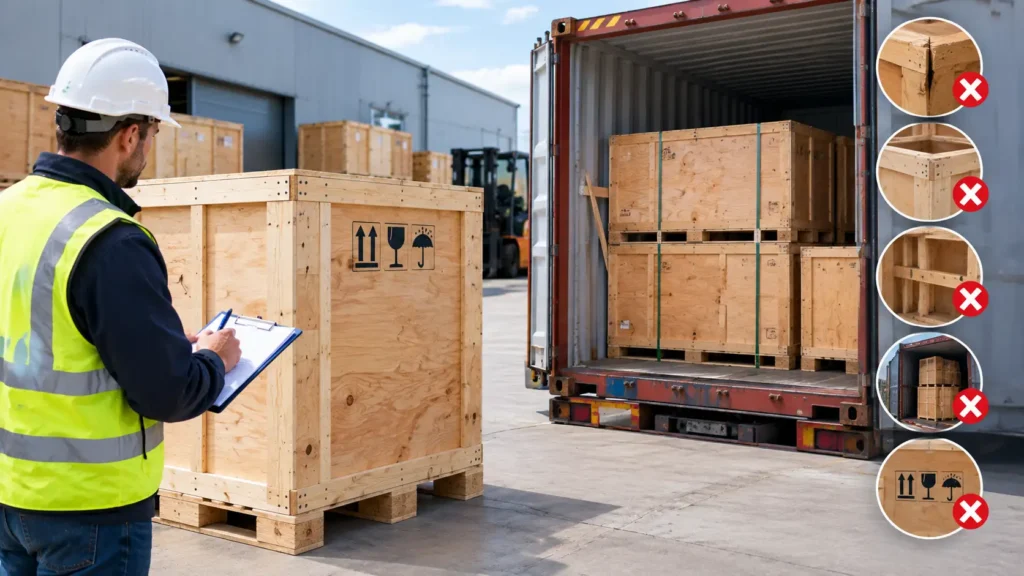
The 5 Most Common Mistakes in Wood Crate and Container Design
And how we avoid them at Advance Pallet and Lumber Ltd.
In wood packaging, a lot of crate and container design still gets done using “rules of thumb.” Sometimes that works. But as shipping routes get longer, loads get heavier, and products get more sensitive (electronics, machinery, high-value parts), the margin for error gets smaller.
At Advance Pallet and Lumber Ltd., we build and support wood packaging that’s meant to protect the product, reduce damage claims, and control total shipping cost. Below are the five most common crate and container design mistakes we see across the industry—explained in plain English—plus what we do differently.
1. Ignoring the Load Path
The mistake: Building a crate without thinking about where the weight actually travels.
A crate is not magic. Weight doesn’t spread evenly by itself. The load must travel from the product → into the crate structure → down into the base/skids → into the floor (or forklift). If that path is unclear, the load will “find” the weakest parts—panels bow, headers split, fasteners pull, skids don’t carry the load, and you end up with a failure.
What it looks like in real life
- Heavy equipment ends up sitting on unsupported boards or thin sheathing
- Skids are placed wrong so they never carry the main forces
- A crate survives the first lift, then fails on the second or third handling event
How we prevent it
- We “trace the load” before we cut lumber. Product → supports → base → forklift points.
- We design the base like it’s doing the real job—because it is.
2. Underestimating Fasteners (and using them wrong)
The mistake: Treating nails/screws/bolts as a minor detail.
Fasteners are often the first failure point—especially when crates experience vibration, bumps, and repeated handling.
Common problems:
- Fasteners driven into end grain (poor holding strength)
- Spacing that’s too wide, so joints “work” loose over time
- Wrong fastener for the job (or wrong length/angle)
- Bolts that loosen from vibration if not planned for
How we at Advance Pallet and Crate prevent it:
- We pick fasteners based on load + vibration + handling, not just habit.
- We avoid designs where key joints rely on weak withdrawal resistance.
- We balance performance and cost: bolts/screws are great, but we only use them where they actually add value.
3. Failing to control product movement
The mistake: Designing only for “how heavy it is” and forgetting “how much it will move.”
Shipping is not smooth. Crates get bumped, tilted, and jolted—especially during loading, unloading, and forklift moves. Even a small side-to-side movement can turn into big stress at the top of tall or top-heavy equipment.
What goes wrong:
- Product rocks inside the crate
- Blocking shifts
- Fasteners loosen
- Damage accelerates quickly once movement starts
How we at Advance Pallet and Crate prevent it:
- We design for lateral forces, not just vertical weight.
- We add proper blocking, bracing, and tie-down points where the product can actually handle it.
- We assume more movement than most people expect—because that’s what reality does.
4. Poor bracing and column design (especially on open crates)
The mistake: Long, skinny columns with little or no bracing.
Open crates can be cost-effective, but they need smart structure. Long unbraced vertical members can buckle much faster than people think. Strength doesn’t drop slowly—it can drop dramatically as length increases.
Easy fixes that get missed
- Mid-height bracing
- Side restraints
- Built-up columns (stronger shapes using similar lumber)
How we at Advance Pallet and Crate prevent it:
- When a crate gets bigger, we re-check proportions instead of copying a smaller design.
- We brace smartly so the crate stays strong without wasting lumber.
5. Designing in a vacuum (ignoring real shipping conditions)
The mistake: Designing as if the crate will live in a perfect environment.
Real shipments face:
- Shock and vibration
- Moisture and weather exposure
- Resonance (some products “shake” at certain frequencies)
- Long dwell times in yards, ports, or warehouses
- Multiple handling points across a route
Some companies respond by overbuilding using extreme specs (which can cost more than necessary). Others do the opposite and rely purely on experience with no standard approach. Neither is ideal.
How we at Advance Pallet and Crate prevent it:
- We match the design to the route reality: handling intensity, product sensitivity, and exposure risk.
- Where needed, we add practical upgrades like better blocking, moisture protection strategies, and impact reduction features—without turning every crate into a “military crate.”
How Advance Pallet and Lumber Ltd. approaches crate design
We keep it simple: protect the product, keep it efficient, and make it repeatable.
Our internal checklist (the “Advance way”)
- Load path clarity: The weight has a planned route into the base
- Forklift reality: Lift points and skid layout match how it will be handled
- Movement control: Blocking/bracing prevents rocking and shifting
- Fastener discipline: Correct type, spacing, direction, and placement
- Right-sizing: Strong enough for the route—without unnecessary cost
- Consistency: If you need repeat shipments, we standardize the design so every build performs the same
Why this matters for pallets and 3PL operations
For warehouses and 3PL networks, poor crate design creates expensive chaos:
- Product damage and claims
- Rework, repacking, and delay
- Dock congestion (because broken loads take time)
- Higher total landed cost, even if the crate looked “cheap” upfront
Good crate design does the opposite:
- Less damage
- Faster handling
- More predictable shipping performance
- Better cost control over time
Bottom line
Most crate failures don’t come from one bad board. They come from design blind spots: unclear load paths, weak joints, uncontrolled movement, missing bracing, and ignoring real shipping conditions.
#CustomCrates #AdvancePallet #newpallet #pallets