
Right now, somewhere in a warehouse near you, a wooden pallet is holding up a stack of boxes, patiently doing a job that almost nobody stops to notice. Yet that simple platform has already travelled further than most of us realize, and its story began long before it reached that warehouse floor.
Follow one pallet from a British Columbia forest to a factory, a delivery truck, a busy dock and, eventually, back to where its journey started, and a quiet system reveals itself: one that keeps shelves stocked, farms connected to markets and factories running on schedule.
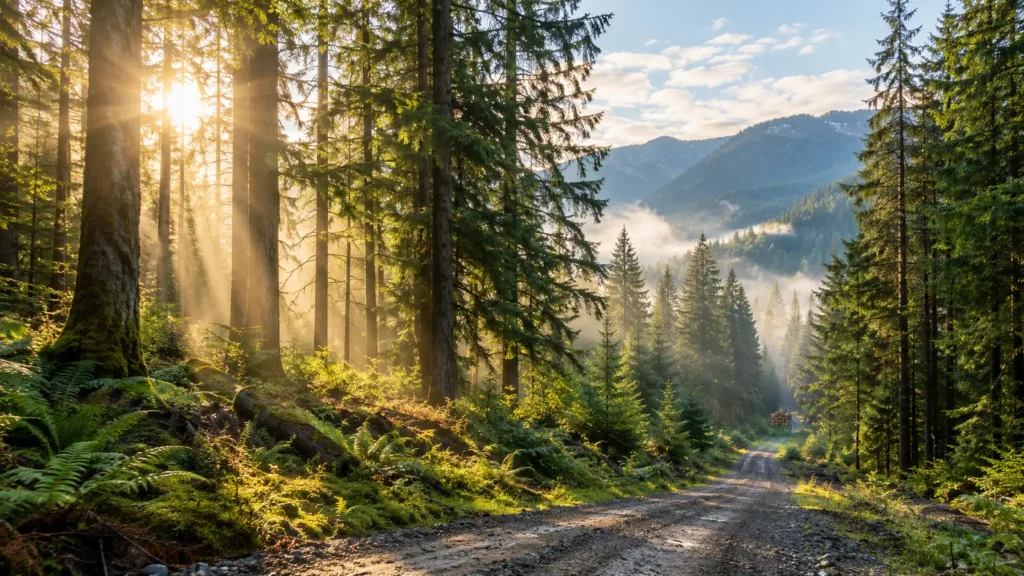
Where It All Begins: A Managed Forest
Every pallet starts as a tree, but not just any tree, and not from just any forest. In Canada, timber for pallets typically comes from forests managed under strict provincial rules, with professional foresters monitoring growth and planning harvest levels so the forest stays healthy for the long term.
Government data backs this up in a reassuring way. According to Environment and Climate Change Canada, the country compares its annual timber harvest against a calculated sustainable wood supply every year, and forests across most provinces are harvested well within that sustainable limit. British Columbia alone accounts for nearly half of Canada’s industrial roundwood harvest, which is one reason the pallet industry has such deep roots here.
At Advance Pallet and Lumber, the lumber used for new pallets is sustainably sourced and FSC certified, manufactured at a facility in Surrey built specifically for the job.
From Logs to Lumber
Once harvested, logs travel to a sawmill where they are cut into boards of standard thickness and width. From there, the wood moves to a pallet manufacturing facility, where it is cut again into the deck boards, stringers and blocks that will soon become a finished pallet.
Good manufacturers do not simply build pallets by habit. Engineering software can model how a pallet will perform under different loads, so the design matches the weight it will actually carry. That kind of planning is why a well built pallet can carry hundreds of kilograms without a second thought, trip after trip.
Built, Stamped and Ready to Travel
A finished pallet is assembled, inspected and, if it is heading overseas, heat treated and stamped to meet the international ISPM 15 standard. That stamp is a small mark with a big job: it tells inspectors in almost any country that the wood has been properly treated and poses no risk to local plant life.
From the factory, pallets are loaded onto trucks and delivered to warehouses, farms, manufacturers and distribution centres across British Columbia and Alberta, ready for their first working trip.
A Day in the Life of a Working Pallet
Picture a single pallet arriving at a food distribution centre. Within an hour it may be loaded with cases of produce, wrapped and placed on a truck bound for a grocery store two hours away. At the store, the same pallet is unloaded, emptied and set aside, then picked up again by a different driver heading back to the distributor.
A pallet rarely makes just one trip. Many are reused dozens of times over several years, moving between businesses that may never even meet, quietly connecting farms, factories and families without anyone giving it a second thought.
What Happens When a Pallet Wears Out
Eventually, after enough trips, a pallet shows its age: a cracked board here, a loose nail there. This is where the journey takes an interesting turn. Instead of ending up in a landfill, a worn pallet is usually collected, inspected and sorted by condition.
Pallets in good shape are graded and sold again as used pallets. Pallets with damaged boards are repaired with new lumber and returned to service. Pallets too worn to repair are broken down, and the lumber is recycled into new products or used as fuel. Very little of the original wood goes to waste.
This cycle has a genuine environmental payoff. Reusing a pallet instead of manufacturing a new one saves roughly 35 kilograms of CO₂, and extending a pallet’s working life conserves close to a third of a mature pine tree. Multiplied across thousands of pallets a year, that quiet recycling loop adds up to a meaningful difference.
Why This Hidden System Matters
It is easy to overlook a pallet. It has no screen, no brand name people recognize and no moment where it takes center stage. Yet without it, the shelves at a local store would empty faster than trucks could refill them, and the cost of moving goods would climb for everyone.
Wood also brings something plastic and metal alternatives cannot match: it is renewable, it stores carbon while it is in use, and it returns easily to nature at the end of its working life. That combination of strength and renewability is part of why wood pallets remain the standard choice across global shipping.
The Journey Continues – Wooden Pallet
Next time you see a stack of pallets outside a loading dock, there is a decent chance one of them started as a tree on a BC hillside, was shaped into a working platform in a Surrey or Calgary facility, and has already quietly completed more trips than most delivery trucks make in a year.
To see where the next chapter of this journey could take your own business, explore how new and used pallets fit different needs, or read more about the thinking behind our approach to sustainability.
Curious where your next pallet could come from? Connect with the Advance Pallet and Lumber team through our contact page and we will help you find the right fit.