
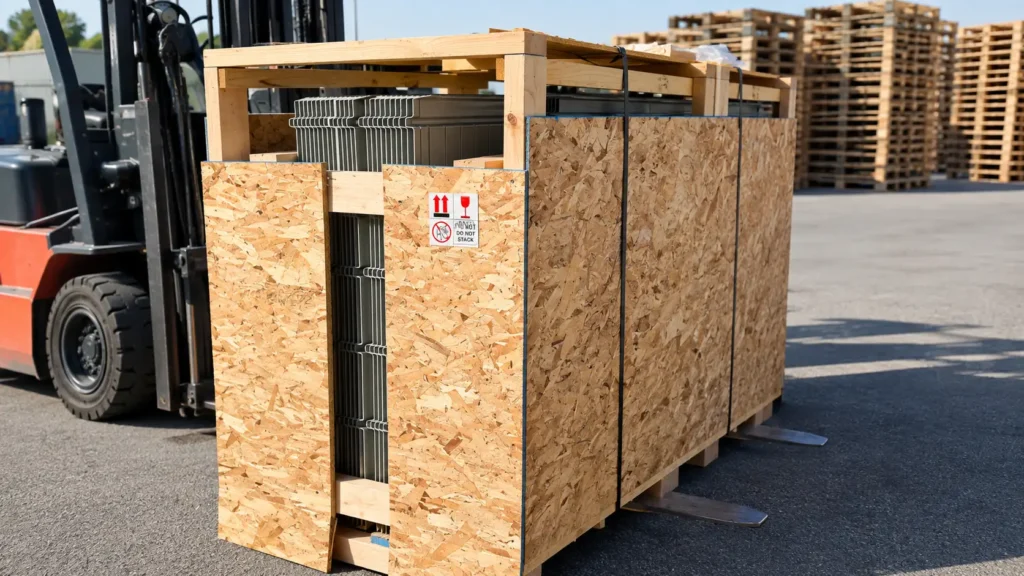
Some shipments are simply too important to leave to chance. A precision machine that took months to build, a set of laboratory instruments, a prototype heading to a trade show: each of these deserves packaging planned around it rather than adapted from something generic. That is where custom wooden crates earn their place.
A well built crate does more than hold a load. It keeps the item steady, spreads weight evenly, protects against weather and gives forklift operators clear handling points. This guide explains how to choose the right design, what to prepare before you ask for a quote, and how to get long term value from the finished crate.
What Sets Custom Wooden Crates Apart From Standard Packaging
A standard box is made to a fixed size and asked to accommodate whatever goes inside. Custom wooden crates work in the opposite direction. The item comes first: its dimensions, weight, centre of gravity, sensitive surfaces and travel route all shape the design, and the crate is built to suit.
In practice, that means bracing that keeps the frame square, blocking that holds the product firmly in place, lift points positioned for the equipment that will move it, and lumber sized for the real load. At Advance Pallet and Lumber, the process begins with a close look at the item and its complete journey. CAD drawings follow for your approval before anything is built, so you can ask questions and refine details while changes are still simple.
Signs Your Shipment Needs Custom Wooden Crates
Standard pallets and cartons handle everyday freight very well. A custom crate becomes the better choice when your shipment fits one of these situations.
- High value. If replacing the item would take weeks and a significant budget, a crate is sensible protection by comparison.
- Unusual shape. Long, tall, cylindrical or uneven items rarely sit well on a standard pallet. They benefit from a frame that follows their outline.
- Sensitivity. Electronics, glass, medical equipment and lab instruments do best when they are fully enclosed, cushioned and held steady.
- A demanding route. Export shipments, remote job sites and journeys with several stops ask more of packaging than a single local delivery, so a stronger structure gives you real peace of mind.
What This Looks Like in Practice
Imagine a research lab in Calgary shipping a calibrated instrument to a partner in Vancouver. The unit is compact, but it is sensitive, heavy for its size and worth far more than the packaging around it. A standard pallet with wrap would hold it in place, yet it would leave the instrument open to shifting, moisture and pressure from other freight.
A fully enclosed crate, built to the instrument’s exact footprint with padded blocking and a clearly marked top, gives it a protected space of its own. Drivers and forklift operators handle it with extra care too, because the crate tells them at a glance that its contents matter.
Choosing Between Crate Styles
Most custom wooden crates fall into one of three families. Each has a place, and the right pick depends on what your item needs most.
| Crate style | Best suited for | Main benefit |
| Fully enclosed crate | Electronics, instruments, medical equipment and prototypes | Complete protection from weather and impact |
| Slatted crate | Heavy machinery, parts and equipment that benefits from airflow | Strong support with ventilation and easy visibility |
| Crate on a custom skid base | Very heavy or oversized equipment | Stable footing and simple forklift handling |
Many custom wooden crates blend these ideas. A slatted crate can carry a fully enclosed top panel, and an enclosed crate can include a ventilation panel when the contents benefit from airflow. A good designer will recommend the combination that suits your cargo instead of steering you toward a single style.
Design Details That Make a Real Difference
Small design choices decide how custom wooden crates perform over their whole journey. These are the ones worth discussing early.
- Bracing and blocking. Inside the crate, the item should stay exactly where it was placed. Wood blocking, straps and cushioning hold it firmly, while diagonal bracing keeps the frame square under load.
- Lift points. Forklift entries, crane hooks and slings should match how the item will actually be moved. Clear markings for the centre of gravity help handlers position forks with confidence.
- Moisture protection. For long trips or outdoor storage, liners and moisture barriers help sensitive contents stay in excellent condition.
- Reusability. If the crate will make repeat trips, hinged or removable panels save time at each stage and extend the crate’s working life.
Materials and Construction: Why the Lumber Matters
A crate is only as strong as the wood and joinery behind it. Quality lumber that is dry, straight and consistently graded holds fasteners well and keeps its shape through changes in temperature and humidity. Panel material, fastener choice and joint layout are matched to the weight of the load, so heavier equipment gets a heavier frame while lighter items are not carried inside an oversized structure.
That balance matters for cost as well. Well engineered custom wooden crates stay efficient: right sized for the load, without extra weight that adds to freight charges. Every product we build uses premium lumber and is made to last, and for export work the lumber is heat treated from the start.
Export Ready Custom Wooden Crates and ISPM 15
When a crate crosses an international border, the wood itself matters as much as the design. Many countries follow ISPM 15, an international standard that expects wood packaging to be heat treated and stamped. The Canadian Food Inspection Agency explains that wood packaging leaving Canada must be debarked, heated so the entire piece, core included, reaches at least 56°C for 30 continuous minutes, and marked by a registered facility.
Advance Pallet and Lumber builds export crates from heat treated, ISPM 15 stamped lumber, so your custom wooden crates reach the border with the mark inspectors expect, together with the documentation international shipping calls for. To understand the standard in more depth, read our guide to ISPM 15 heat treated pallets, or explore our heat treated pallet options for the base that sits beneath your crate.
What to Prepare Before You Request a Quote
A short conversation goes much further when you arrive with the right details. When you request a quote for custom wooden crates, it helps to gather the following:
- Item dimensions and weight, including any parts that extend outward
- Photos or drawings, with notes on delicate surfaces
- The route the crate will travel: road, sea, air or a combination
- Whether the crate will be opened and reused
- The handling equipment available at each end, such as forklifts or cranes
- Your target delivery date
Partial answers are still useful. An experienced crate designer will ask the follow up questions and help fill any gaps.
Bring Your Crate Builder In Early
The best time to talk about a crate is while the item is still being finished, not the week before it ships. Early conversations let the designer plan materials, arrange a site visit when it makes sense and schedule the build around your timeline. For export projects, early planning also leaves room to confirm destination requirements and prepare documentation.
Teams that involve their crate builder early usually find the whole process calmer, because every decision is made with time to spare.
Looking at the Value Side of Custom Crates
It is natural to compare the price of a crate with the price of a pallet and a roll of wrap. A more useful comparison is between the crate and everything it protects: the item itself, the schedule it supports and the customer waiting for it. A crate that arrives with its contents in perfect condition, and can be reused on your next project, keeps giving value long after delivery.
Wood is also a renewable material. When a crate reaches the end of its working life, the lumber can be repaired or recycled, which fits the approach described on our sustainability page. That makes custom wooden crates a practical choice for businesses that care about both protection and responsible packaging.
How Advance Pallet and Lumber Builds Your Crate
Since 1996, our teams in British Columbia and Alberta have built protective packaging for machinery, electronics and one of a kind equipment. The process is straightforward. We assess your item and its journey, prepare CAD drawings for your approval and build the crate in our BC or Alberta workshops. The item is then secured inside, often at your own facility for convenience, and the finished crate is inspected and delivered with handling documentation.
If your cargo needs a purpose built base, our custom pallets and skids are engineered from the ground up for the load, and our custom crates page shows more of the custom wooden crates we can build. We serve customers in Vancouver, Surrey, Kelowna and Calgary.
Start With the Item, Then Build the Crate
The best crate is the one designed around the thing inside it. Custom wooden crates work best when you share the details early, because your crate builder can then plan bracing, materials and handling points that suit your shipment from the first drawing to final delivery. That preparation is what turns a good crate into a dependable one.
Have a shipment that needs extra protection? Connect with the Advance Pallet and Lumber team through our contact page and we will help you design the right crate.